The Catholic Our Father Prayer
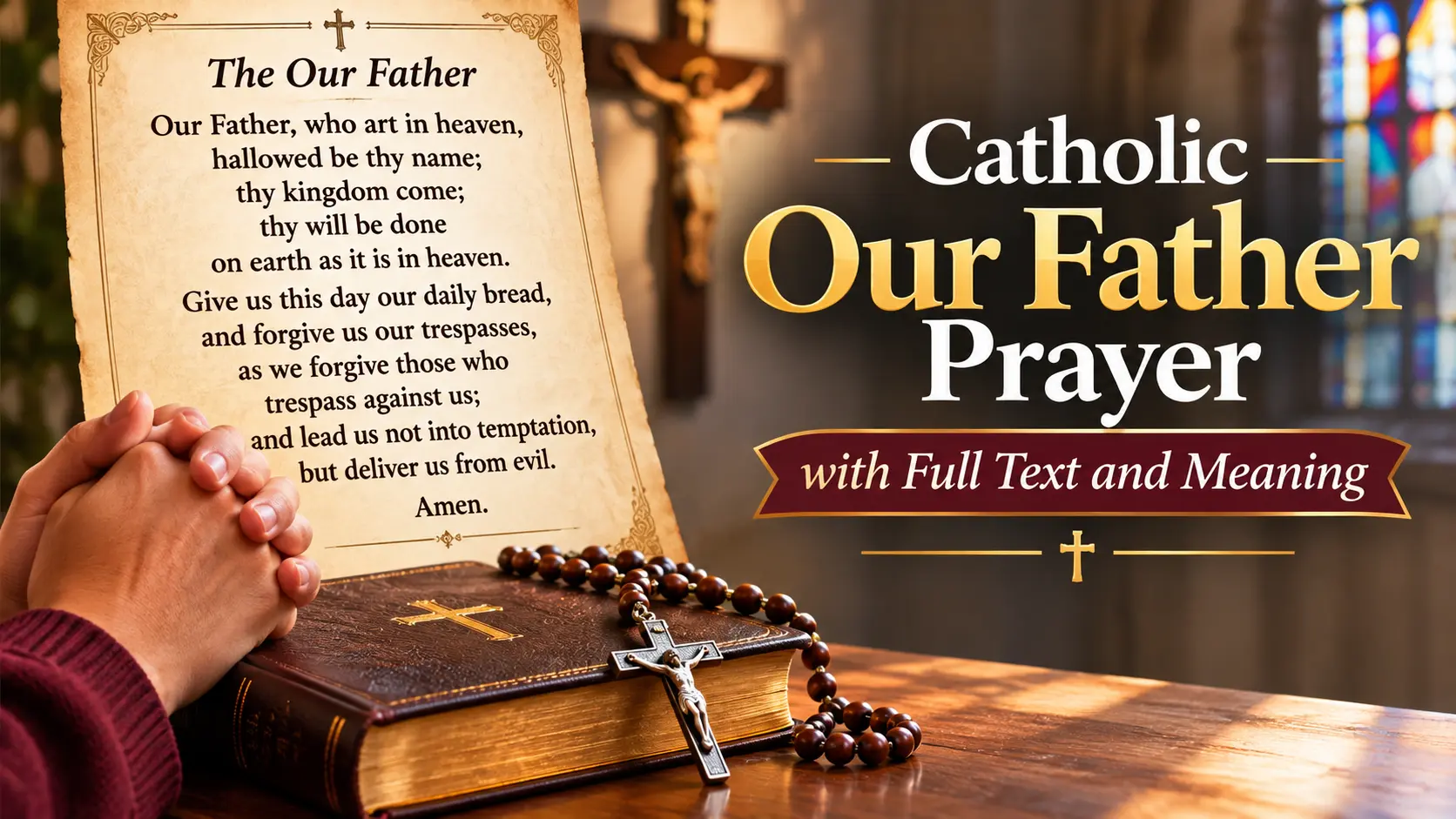
The traditional English version of the Our Father used by Catholics is given below. Its words are recited during personal prayer and communal worship, although the ending follows a slightly different arrangement during Mass.
Our Father, who art in heaven,
hallowed be thy name;
thy kingdom come,
thy will be done
on earth as it is in heaven.
Give us this day our daily bread,
and forgive us our trespasses,
as we forgive those who trespass against us;
and lead us not into temptation,
but deliver us from evil.
Amen.
The prayer begins by honouring God before turning toward human needs. Its seven petitions express a relationship in which believers approach the Father with reverence, trust, repentance and a willingness to live according to His teaching.
Biblical Origins
The Our Father comes from the teaching of Jesus recorded in Matthew 6:9–13 and Luke 11:2–4. Both passages preserve His instruction about prayer, although they differ in wording and length.
In Matthew's Gospel, Jesus teaches the prayer during the Sermon on the Mount. Before giving its words, He warns against praying to attract admiration and against assuming that lengthy repetition makes prayer more effective.
This setting reveals the importance of sincerity in Christian prayer. Jesus directs His disciples toward genuine dependence upon God rather than outward religious performance.
Luke records a disciple asking Jesus to teach them how to pray. His account contains a shorter form, while Matthew preserves the fuller version traditionally used in Catholic worship.
The Catechism of the Catholic Church explains this distinction in paragraph 2759. Catholic liturgical tradition retains the seven-petition form found in Matthew's Gospel.
Meaning of the Seven Petitions
The prayer begins by addressing God as Father, expressing the relationship believers have with Him through Jesus Christ. The word our also reminds Christians that prayer extends beyond individual concerns to the wider community of faith.
The reference to heaven acknowledges God's holiness and majesty without suggesting that He is distant from human life. Catholics understand His fatherly care as a source of trust while recognizing that God's nature exceeds every earthly comparison.
The seven petitions follow a meaningful order. The first three concern God's name, kingdom and will, while the remaining four express human needs for provision, forgiveness, protection from temptation and deliverance from evil.
Hallowed Be Thy Name
The word hallowed means holy or treated as holy. This petition asks that God's name be honoured and His holiness recognized in worship and daily life.
Its meaning extends beyond speaking respectfully about God. Believers are also called to reflect reverence for Him through their conduct, relationships and decisions, allowing their actions to agree with the faith they profess.
Thy Kingdom Come
This petition expresses the desire for God's reign to be fully established. Christians look toward the fulfillment of His kingdom while seeking to live according to its values in the present.
The request encourages concern for justice, mercy, truth and righteousness rather than focusing exclusively on personal circumstances. In Catholic teaching, it also points toward the hope of Christ's return and the final fulfillment of God's saving purposes.
Thy Will Be Done
Asking for God's will to be done expresses trust in His wisdom. It is a willingness to seek what is right, even when personal desires or expectations point in another direction.
This does not mean believers must pretend uncertainty, disappointment or suffering is easy to accept. Jesus Himself expressed deep anguish while praying in Gethsemane, yet submitted to the Father's will.
Matthew 26:39 provides an important example of this obedience. The petition invites Christians to seek God's guidance while remaining faithful through circumstances they can not fully understand.
Give Us Our Daily Bread
The request for daily bread acknowledges human dependence upon God's provision. Food, shelter and other necessities are legitimate concerns to bring before Him.
Its emphasis on daily needs encourages gratitude for ordinary provisions that can easily be overlooked. It also reminds those who have sufficient resources to recognize the needs of people facing hunger or material hardship.
In Catholic teaching, this petition carries an additional Eucharistic meaning. The Catechism connects the request for bread with spiritual nourishment through Christ, particularly in the Eucharist.
These meanings complement rather than replace one another. Believers ask God to sustain their earthly lives while recognizing their deeper need for communion with Him.
Forgive Us Our Trespasses
This petition acknowledges the need for God's mercy. Through it, Catholics recognize that their thoughts, words and actions do not always reflect the love and obedience God requires.
The prayer immediately connects the forgiveness sought from God with the willingness to forgive others. Jesus reinforces this responsibility in Matthew 6:14–15, where He continues discussing forgiveness after teaching the Lord's Prayer.
Forgiveness can be difficult when another person's actions have caused genuine harm. Nevertheless, the petition calls believers to resist revenge and bitterness while seeking the grace to forgive.
This does not mean serious wrongdoing must be ignored or that broken trust must automatically be restored. Forgiveness can coexist with appropriate boundaries, accountability and the pursuit of justice.
Lead Us Not Into Temptation
This petition is sometimes misunderstood because its wording can suggest that God deliberately leads people toward sin. Scripture, however, teaches that God does not tempt anyone to commit evil, as explained in James 1:13.
Catholic teaching understands the petition as a request for God's help in resisting temptation and avoiding choices that lead away from Him. It recognizes that human weakness makes spiritual vigilance necessary.
Temptation may arise through anger, dishonesty, envy, pride or other struggles. By praying these words, believers seek wisdom to recognize what is wrong and strength to choose what is right.
The request encourages humility rather than overconfidence. It reminds Christians that resisting temptation requires personal responsibility supported by dependence upon God's grace.
Deliver Us From Evil
The final petition asks God for deliverance from evil. Catholic teaching understands this request in relation to the reality of evil, including the influence of the evil one.
It expresses the need for divine help against spiritual dangers that threaten faith and obedience. Believers acknowledge that their own judgment and strength are not always sufficient when confronting evil.
This petition does not promise freedom from every hardship or painful experience. Instead, it asks for God's saving protection and the grace to remain faithful amid life's difficulties.
The prayer ends its petitions by turning toward God for deliverance. Its final request reflects the same dependence upon Him expressed throughout the Our Father.
Why Catholics Say Trespasses
One noticeable difference between the traditional Catholic Our Father and the King James Version of Matthew 6 concerns the language of forgiveness. Catholics commonly pray using trespasses, while Matthew 6:12 in the KJV uses debts and debtors.
Both expressions concern wrongdoing and the need for forgiveness. The language of debts presents sin in terms of an obligation owed, while trespasses emphasizes offenses committed against God or others.
Interestingly, the KJV uses the word trespasses immediately after the Lord's Prayer. In Matthew 6:14–15, Jesus speaks about forgiving others and the importance of receiving and extending forgiveness.
The traditional Catholic wording therefore reflects a longstanding English prayer tradition rather than a fundamentally different understanding of forgiveness. Both expressions belong to the biblical teaching on sin, mercy and reconciliation.
The Doxology at Mass
Some Christians conclude the Lord's Prayer with a doxology beginning with For thine is the kingdom. This conclusion appears in the King James Version of Matthew 6:13, although it is absent from some other biblical textual traditions.
The traditional Catholic Our Father does not normally include this doxology as part of its standalone wording. When Catholics pray the Our Father privately or during the Rosary, they ordinarily conclude with Amen after asking for deliverance from evil.
During Mass in the Roman Rite, however, the congregation does not say Amen immediately after the Our Father. Instead, the priest continues with an additional prayer called the embolism.
The embolism develops the final petition by asking God for deliverance from evil and the gift of peace. After the priest finishes, the congregation responds:
For the kingdom, the power and the glory are yours now and for ever.
Catholics therefore use these familiar words of praise but their position within the Mass differs from the way some other Christian traditions conclude the Lord's Prayer. The distinction concerns the structure of Catholic liturgical worship rather than a rejection of the doxology.
The Catechism discusses this tradition in paragraphs 2760 and 2855–2856. Its placement within the Roman Catholic Mass reflects the established arrangement of the Communion Rite.
When Catholics Pray It
The Our Father is an essential part of Catholic Mass. It is recited during the Communion Rite, after the Eucharistic Prayer and before the Rite of Peace.
Its position is especially meaningful because the congregation is preparing to receive Holy Communion. The petitions concerning daily bread, forgiveness and deliverance are closely connected with this preparation.
The Our Father also forms part of the Rosary. Each decade begins with the Lord's Prayer, followed by ten Hail Mary prayers and the concluding Glory Be.
Those learning the Rosary may also wish to become familiar with the Hail Mary prayer, which accompanies the Our Father throughout this devotion. Together, these prayers help structure meditation on the mysteries of Christ's life.
Outside formal worship, Catholics may pray the Our Father upon waking, before sleeping or during moments of uncertainty. Its familiar wording makes it suitable for quiet reflection, family prayer and occasions when someone finds it difficult to express personal concerns.
Because the prayer uses our and us, it encourages concern for other people as well. Even when spoken alone, its petitions extend beyond the individual praying.
Praying With Attention
The Our Father is often learned in childhood and remembered throughout life. Familiarity can make it easier to pray, although repeated words sometimes become automatic when their meaning receives little attention.
One way to pray more thoughtfully is to slow down and consider each petition. Someone struggling with conflict may reflect on forgiveness, while a person facing uncertainty may spend more time considering God's will.
The request for daily bread can encourage gratitude for ordinary necessities. Similarly, the petition concerning temptation may help someone recognize situations in which greater patience, honesty or self-control is needed.
These reflections do not require changing the traditional words. Rather, they help the person praying recognize how the teachings of Jesus relate to everyday responsibilities and decisions.
Prayer also does not require a particular emotional experience to be sincere. A person may recite the Our Father during an ordinary or difficult day without feeling anything extraordinary, yet still approach God with genuine faith.
The lasting value of the Our Father comes from the instruction of Jesus and the relationship with God that its words express. Whether offered during Mass or in personal devotion, the prayer directs believers toward worship, forgiveness, trust and a life shaped by God's will.